

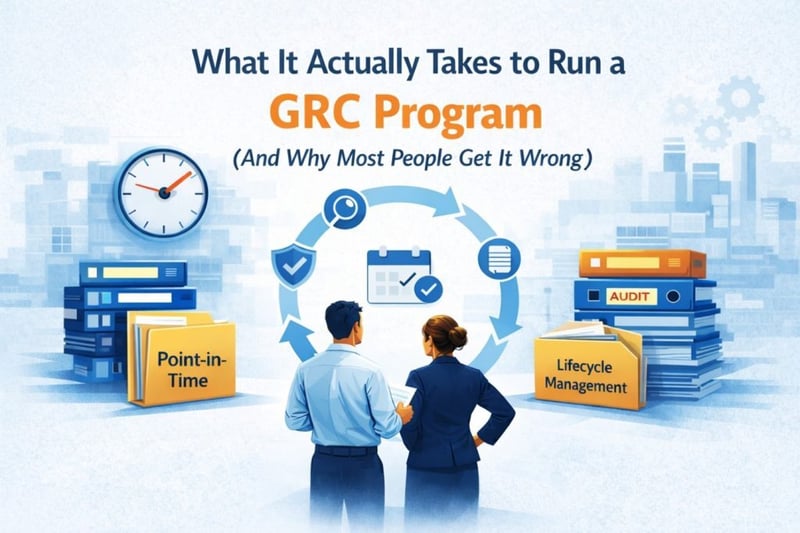
Most people think running a GRC program is about getting ready for audits.
That’s understandable. Audits are the visible part. They’re loud, stressful, and time-bound. They’re also the moment everyone remembers GRC exists.
But audits are not the job.
The job is what happens on a random Tuesday in the middle of the quarter when a control owner has changed roles, when a strategic acquisition is announced, a new landmark customer requires a new security certification, and someone asks whether last year’s evidence “should still be fine.”
Running a GRC program is an operational role. It takes business acumen. It takes influence and collaboration with stakeholders across the business. It’s ongoing. It’s messy. And it doesn’t care whether you just passed an audit six weeks ago.
We know this because we’ve lived it. For over a decade, we’ve operated GRC programs across SOC 2, ISO 27001, PCI, HIPAA, and more. All inside real companies, under real scrutiny, with real consequences when things went wrong.
And the biggest mistake we see, over and over, is treating GRC like a project instead of a strategic function.
What Running a GRC Program Actually Involves
If you’ve never had to run a GRC program, it’s easy to assume the work clusters around audit season.
In reality, the audit is just the moment everything becomes visible.
The actual job lives in the weeks and months in between - when there’s no external deadline forcing alignment, and the program either strategically aligns to the business, holds together operationally, or slowly degrades to a green check-the-box function.
Here’s what that work really looks like.
Evidence Never Stops Coming (or Expiring)
Evidence isn’t something you “collect.” It’s something you continuously chase, validate, refresh, and re-explain.
Screenshots go stale. Reports change formats. Logs rotate. Access reviews that made sense six months ago don’t reflect today’s org chart.
And none of this happens in one place.
Evidence lives in:
- Ticketing systems
- Cloud consoles
- HR platforms
- Security tools
- Shared drives
- Someone’s inbox
- Someone else’s head
Running a GRC program means constantly reconciling what the framework expects with what the business actually produces - without breaking either.
Controls Drift, Even When No One Is Doing Anything “Wrong”
One of the hardest truths to accept as an operator is that control failures are not due to negligence, but rather a natural result of the business environment.
Teams change.
Tools get swapped.
Processes evolve quietly.
Responsibilities shift during reorganizations.
A workaround becomes the default.
The control didn’t “fail.” The world moved, and the control didn’t move with it.
If you’re running GRC, you’re constantly asking:
- Does this control still reflect reality?
- Is it being performed the way we think it is?
- Is there a better way we should be doing this?
- Would we be comfortable defending this under scrutiny today - not last year?
That work is invisible when done well. And painfully obvious when it’s not.
Most of the Work Is Human Coordination
Frameworks don’t struggle. People do.
Running a GRC program is largely about:
- Following up without burning trust
- Translating requirements into language teams actually understand
- Explaining why something matters (for the tenth time)
- Getting partial answers and turning them into defensible outcomes
- Knowing when to push and when to adapt
None of that shows up in a control matrix.
But it’s the difference between a program that scales and one that collapses under its own weight.
Audits Are Periodic. Scrutiny Is Constant.
Even outside formal audits, GRC never really turns off.
Customers ask questions.
Sales needs answers.
Security incidents trigger reviews.
Leadership wants confidence.
Regulators evolve expectations.
When you run a GRC program, you’re always at least partially “on stage.” And the goal isn’t perfection. Or at least it shouldn’t be.
It’s being able to say, calmly and honestly: “Here’s how this works today, here’s how we know, and here’s what we’re improving.”
That confidence only comes from operational clarity, alignment with the business’s objectives, and trust from leadership.
The Real Cost Is Cognitive Load
The part that rarely gets acknowledged is how mentally taxing this job is.
You’re tracking:
- Framework requirements
- Evidence status
- Control ownership
- Exceptions
- Compensating controls
- Auditor interpretations
- Business changes
- Deadlines that move
All at once.
Most teams don’t fail because they don’t care. They fail because the mental overhead becomes unsustainable. And that’s the moment when people start cutting corners. Not out of laziness, but out of survival.
Why Smart Teams Still Get It Wrong
Most GRC programs that struggle aren’t run by careless people.
They’re run by capable teams doing their best inside systems and assumptions that don’t match the reality of GRC operations.
We know this because we made many of these same mistakes ourselves – born from experience running 100s of programs - before we understood what the job was actually asking of us.
They Treat GRC Like a Project With an End Date
This is the most common - and most damaging - assumption.
The idea usually sounds like:
- “Let’s get through this audit.”
- “Once we’re certified, things will settle down.”
- “We just need to stand this up.”
But GRC doesn’t stabilize after the audit. It resets. Or rather it continues.
Running a GRC program means accepting that there is no finish line. There’s only a steady state you’re constantly trying to maintain as the business changes around it.
There are strategic pivots. New requirements. And constant realignment to help the business remain competitive, manage risks, and serve customers.
Teams that plan for “done” are always surprised by what comes next.
They Optimize for the Audit Instead of the GRC Program
Audits are loud. Programs are quiet.
So naturally, teams optimize for what’s measured:
- Passing the audit
- Minimizing findings
- Getting the report out the door
Over time, that creates a dangerous inversion:
- Evidence exists to satisfy auditors, not to reflect reality
- Controls are written to sound right, not to work well
- Risk decisions get deferred because they’re inconvenient mid-audit
- The green checkbox in a GRC tool
The audit gets easier. The program gets weaker.
And eventually, the gap shows up in places audits weren’t designed to catch.
This is a dangerous trap for GRC professionals.
They Rely on Tools or Templates That Assume Perfect Inputs
Most GRC tooling and most “best practice” advice assumes:
- Clean ownership
- Stable processes
- Rigid systems
- Consistent interpretations
- Static controls
Real environments are none of those things.
When tools make these kinds of assumptions, the burden shifts back to humans to compensate:
- Manually reconciling inconsistencies
- Explaining gaps repeatedly
- Tracking context in their heads
- Creating side spreadsheets “just for now”
- Accepting a dishonest version of the program
That type of work is where programs quietly collapse.
They Confuse Documentation With Control Effectiveness
Documentation is another thing. Yes, it is necessary. But no, it is not sufficient.
You can have:
- The perfect templates
- Beautifully written policies
- Complete control descriptions
- Well-organized evidence folders
And still have controls that don’t actually operate the way they’re described. I can’t tell you how many times I have seen engineering teams role their eyes when reading an SDLC policy masterfully written by a GRC team.
Things exist on paper, but to no match the reality on the ground. Or the match the reality that was happening two years ago.
The burden of running a GRC program means constantly validating:
- Is this control actually happening?
- Is it happening consistently?
- Would we stand behind this if challenged?
When documentation becomes the proxy for reality in an effort to align with a framework or pass an audit - risk doesn’t go away - it just gets harder to see.
They Underestimate How Much the Job Changes Over Time
The job of running GRC changes all the time.
Framework scope expands.
Stakeholders multiply.
Evidence volume explodes.
Tolerance for manual work disappears.
Teams don’t fail because they didn’t plan well enough. They fail because the program outgrows the assumptions it was built on and no one has time to rebuild it mid-flight.
So what’s the fix?
The GRC Operator Insight Most Advice Misses
After enough years of running GRC programs, a pattern becomes impossible to ignore.
Most failures don’t come from a lack of effort, intelligence, or intent.
They come from a mismatch between how GRC is described and how it actually operates.
GRC isn’t a set of frameworks.
It’s a set of lifecycles.
Evidence has a lifecycle.
Controls have a lifecycle.
Risks have a lifecycle.
Vendors have a lifecycle.
Policies have a lifecycle.
And each of those lifecycles continues whether an audit is happening or not.
Once you see GRC this way, a lot of common frustrations suddenly make sense:
- Why work seems to repeat itself every year
- Why “one more framework” feels exponentially harder
- Why teams feel busy but still exposed
- Why confidence disappears between audits
The problem was never that people weren’t working hard enough. The problem was that we were asking humans to manually sustain too many parallel lifecycles indefinitely.
That’s not a discipline issue.
It’s an operating model issue.
This Is Where Our Perspective Comes From
We didn’t arrive at this insight from theory or tooling.
We arrived at it the hard way - by operating GRC programs for over a decade, across SOC 2, ISO 27001, PCI, HIPAA, and more, inside real organizations where GRC was tied directly to revenue and trust.
We are GRC operators who have earned the right to build AI agents.
We didn’t start with AI and look for GRC problems. We spent a decade drowning in GRC problems - and AI agents were the only thing that finally made sense.
That conclusion didn’t come from optimism. It came from exhaustion, pattern recognition, and a deep respect for how hard this job actually is.
The Shift That Changes Everything
When you accept that GRC is lifecycle-driven, not audit-driven, the question changes.
It’s no longer:
- “How do we pass the next audit?”
It becomes:
- “How do we continuously align our program to meet the business’s objectives?”
That shift forces a different approach to resourcing:
- Humans focus on judgment, context, and decisions
- Operational work is sustained continuously, not heroically
- Confidence is built incrementally, not in sprints
This isn’t about replacing teams.
It’s about finally giving GRC professionals a model that matches the reality they’ve been living in.
Why This Forces a Different Operating Model
Once you accept that GRC is sustained through lifecycles - not projects - the old operating model starts to break down.
Most GRC programs were built for moments:
- Audit windows
- Certification milestones
- Customer escalations
- Board questions
They were never designed for continuity.
So teams compensate the only way they know how:
- Heroic effort before audits
- Manual tracking between reviews
- Spreadsheets to bridge gaps
- Institutional knowledge living in a few exhausted people
That approach can work for a while.
But as scope grows, frameworks multiply, and expectations rise, the math stops working. The volume of work increases faster than human capacity to manage it manually.
At that point, something has to change. Not because teams are failing, but because the GRC operating model is.
The programs that hold up over time are the ones that:
- Treat GRC as an always-on function
- Reduce reliance on memory and manual coordination
- Sustain operational work continuously instead of in bursts
- Let humans focus on judgment, not maintenance
Checkbox theater has to end. This is about empowering GRC professionals to do what’s right by the business.
What Changes When the Model Finally Matches the Job
When GRC is treated as a real operational discipline - not a recurring emergency or a green checkbox - something subtle but important happens.
The work feels different.
Teams stop bracing for audits and start trusting their understanding of the program. Evidence doesn’t feel like a scavenger hunt. Control conversations become forward-looking instead of defensive.
Instead of asking:
- “Do we have this somewhere?”
- “Can we make this pass?”
- “Will this hold up?”
Teams start asking:
- “Is this still true?”
- “Does this reflect how we operate today?”
- “What changed, and how do we adapt?”
That shift doesn’t eliminate effort. It eliminates waste. It eliminates the façade or security theatre.
It gives leaders confidence and gives power back to GRC teams. Not because everything is perfect, but because the program is understandable, defensible, and improving over time.
That’s what real GRC maturity looks like.
The Point Most People Miss
Security will never be perfect. It can’t be.
But it can be honest, consistent, and operationally sound under constant change.
Anyone can pass an audit once. Very few teams can sustain trust year after year without burning out.
The difference isn’t intelligence or intent. It’s whether the operating model respects the reality of the job.
We’ve lived that reality.
We’ve felt the pressure of audits tied to revenue. We’ve watched good teams drown in manual work. We’ve seen what breaks and what finally holds.
That’s why we’re opinionated about this space. And it’s why our approach looks different.
Not because we wanted it to.
But because after a decade of running GRC programs, it is the only thing that makes sense.
 Christian Hyatt