

Most GRC leaders didn’t buy a GRC platform because they were chasing shiny objects or trying to impress the board with new software.
They bought one for good reasons.
They wanted to find efficiency, to scale a program that had outgrown spreadsheets and inboxes, and to operationalize compliance in a way that felt sustainable.
On paper, the decision was rational.
A centralized system of record, standardized workflows, framework mappings done once instead of rebuilt every audit, and dashboards leadership could finally trust all sounded like the natural next step for a maturing program.
For teams already overwhelmed by evidence requests and audit cycles, purchasing a GRC platform felt like the responsible move.
And yet, years later, many of those same leaders will quietly admit the outcome didn’t match the intent. Instead of gaining leverage, they found themselves spending more time managing the tool than managing risk.
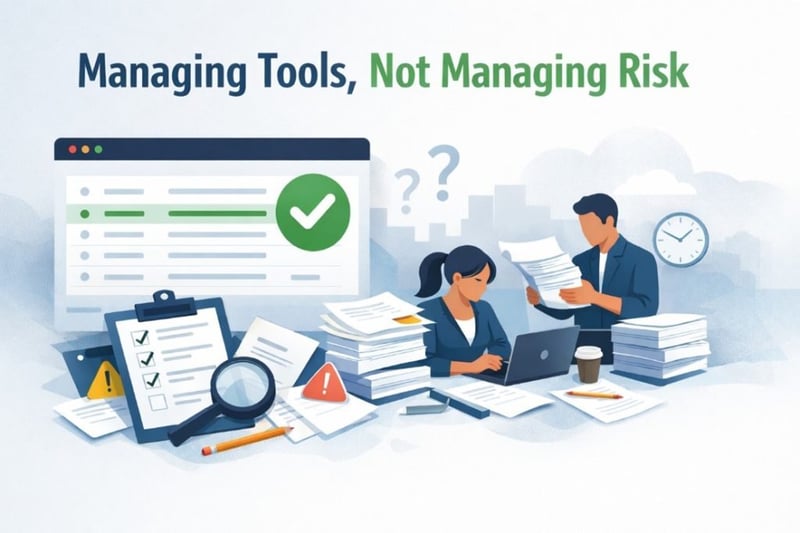
How the promise breaks down in practice
The gap between what GRC platforms promise and what they deliver rarely shows up immediately. Early on, implementations often look successful. Frameworks are loaded, controls are mapped, evidence repositories are created, green checkmarks are shining, and there is a shared sense that the hard work is finally behind the team.
Then the business keeps moving.
Engineering teams ship changes. Vendors evolve. Systems are reconfigured. Acquisitions happen. Controls drift in subtle ways that are hard to detect but easy to miss. A new framework is added.
Soon part of the team falls back to the good ole fashioned excel spreadsheet.
Failed implementations are more common than anyone admits
After operating GRC programs for years, one pattern becomes hard to ignore: failed or partially adopted GRC platforms are far more common than fully successful ones.
By a long shot.
These failures are rarely about effort or intent. Teams invest real time in implementation, training, and configuration. Leaders push for adoption. Practitioners genuinely try to make the platform part of their workflow.
The problem is structural.
Most tools assume GRC work is cleaner, more predictable, and more static than it actually is. So the GRC tools tries to force you into a rigid structure that doesn’t meet the reality of your program.
When that assumption collides with reality, teams adapt in predictable ways. They use the platform heavily right before audits, do the real work elsewhere, and treat the tool as a documentation layer rather than an operational one.
Under-adoption is a signal, not a discipline problem
When a platform is underused, the default explanation is often that teams need more training or stronger enforcement. In practice, most GRC leaders know their tools well. They understand how to use them and what they are capable of.
They also understand when using the platform adds friction instead of removing it.
So they make practical tradeoffs. They track reality in spreadsheets because it is faster. They chase evidence in Slack and email because that is where the work actually happens. They reconcile the platform later to keep auditors satisfied.
When things are done like this it creates two parallel programs. The tool doesn’t disappear, but it stops being trusted as a source of truth.
The quiet danger of green checkmarks
One of the more subtle failures of traditional GRC tooling is not inefficiency but misplaced confidence. Dashboards look clean. Controls are marked effective. Everything appears green.
On the surface, that order is reassuring. For leadership, it signals control. For GRC teams, it feels like progress. For auditors, it looks like preparedness.
But across the industry, there is a quiet and growing skepticism about what those green checkmarks actually mean.
Many experienced GRC practitioners no longer fully trust them. Neither do many auditors.
That skepticism isn’t philosophical. It’s operational.
In most platforms, a green status reflects administrative completion rather than operational reality. Evidence was uploaded once. A policy exists. A configuration setting was correct in one environment, at one point in time. Someone attested based on what they knew in that moment. None of that guarantees the control is still operating as intended today, across the full scope of the environment.
The problem is not that the data is wrong. It’s that it’s incomplete, stale, or abstracted away from how the control actually lives in the business.
Auditors feel this gap as well. Even when they see a fully populated platform with clean dashboards, they still ask for walkthroughs, screenshots, system queries, and live explanations. They probe not because they distrust the team, but because they know the platform cannot always show how or where a control is operating—only that it was documented.
That dynamic creates an uncomfortable tension. GRC teams are told to rely on the platform, while auditors continue to verify outside of it. The result is duplicated work and a subtle erosion of trust in the system that was supposed to centralize everything.
Over time, teams stop interrogating the signal. The platform feels authoritative because it looks organized and complete, even when the data underneath it is aging. Green checkmarks begin to substitute for ongoing judgment. Instead of asking whether a control is drifting, teams ask whether the status is still green.
That’s the real danger. Not that tools are wrong, but that they create a false sense of certainty in environments that are constantly changing.
When confidence comes from presentation rather than transparency, risk doesn’t disappear. It just becomes harder to see.
When tools start outsourcing your thinking
This is where many programs cross an invisible line. Instead of supporting decision-making, the platform begins to define it.
Pre-built frameworks shape what “good” looks like. Rigid workflows dictate how work should happen. Exceptions feel like failures instead of normal consequences of running a real business.
Gradually, teams stop asking whether a control meaningfully reduces risk in their specific environment and start asking whether the box is checked. That shift is not driven by laziness. It is driven by fatigue and by tools that reward order over truth.
This line of thinking is bad for the entire industry.
What teams usually try next
When frustration peaks, most GRC leaders respond pragmatically. If the platform can’t reliably reflect what’s actually happening, they fall back to what they know will work under audit pressure.
They ask control owners to send evidence directly. Screenshots, exports, configuration files, and ticket links start arriving over email, Slack, and shared drives. The GRC team manually reviews each item, checks it against the control intent, and decides whether it’s good enough for the auditor.
To keep things organized, parallel trackers emerge. Spreadsheets are created to log what was requested, what was received, what still needs follow-up, and what has been approved. The platform remains open in another tab, but it’s no longer driving the work. It’s something the team plans to reconcile later.
As the audit approaches, the focus shifts to packaging. Evidence is renamed, dated, annotated, and bundled so it can be confidently handed over to the auditor. Questions are answered live. Clarifications happen in meetings. The audit moves forward - not because the platform made it easier, but because the team reverted to manual control validation.
When the audit is over, some of that evidence is uploaded back into the tool to restore the appearance of completeness. Green checkmarks return. But everyone involved knows the truth: the real work happened outside the system.
What’s left is a program running in parallel. One path reflects operational reality, managed manually by the team. The other reflects documented compliance, maintained to satisfy the platform.
This approach gets teams through audits. It always has. But it quietly resets the program to the old way of working, with more tools to maintain and the same underlying risk visibility gaps as before.
The operator realization we had to confront
This is why we have concluded that GRC AI Agents are the only rational solution. And we didn’t come to this conclusion as commentators.
We came to it by operating SOC 2, ISO 27001, PCI DSS, HITRUST, SOX, HIPAA, and now ISO 42001 programs across hundreds of companies.
We watched strong teams spend more energy maintaining systems than improving controls. We watched platforms meant to create leverage become another surface area that needed constant care.
Eventually, we had to be honest with ourselves. Traditional GRC platforms do not keep up with dynamic compliance environments. They don’t work the way GRC teams work.
We didn’t start with AI and look for compliance problems. We spent a decade drowning in compliance problems - and AI agents were the only thing that finally made sense.
Why lifecycle thinking changes the equation
What I realized is that real GRC work is continuous.
Evidence has a lifecycle.
Controls have a lifecycle.
Vendors have a lifecycle.
Policies have a lifecycle.
When tools treat these as one-time artifacts, teams are forced to bridge the gap manually. When work is managed as a lifecycle instead, drift becomes visible earlier, evidence stays current, and judgment remains with humans.
This is where agents belong.
Not as replacements for GRC teams but as teammates that stay present between audits and support the work that actually matters.
We are GRC operators who have earned the right to build AI agents.
The outcome GRC leaders actually want
Most GRC leaders are not trying to automate themselves out of a job. They are trying to stop wasting time on work that does not reduce risk.
They want to focus on risk. They want to run an efficient program. And they want to free their team up to do the work only they can do. Namely, thinking.
A grounded view forward
The future of GRC is not another platform promise. It is a recognition that compliance programs are living systems and need support that reflects that reality.
Less time managing tools. More time managing risk.
That conclusion does not come from theory or hype. It comes from lived experience running the work.
 Christian Hyatt