

For years, too many talented people entered GRC expecting to do meaningful, high-impact work only to find themselves stuck chasing screenshots, organizing evidence folders, and repeatedly following up with engineers for audit artifacts.
That was never supposed to be the job.
And yet, for much of the last decade, that has been the reality of the GRC profession. Smart, capable professionals have spent a disproportionate amount of their time on manual administrative work supporting compliance instead of using the judgment and expertise that made them valuable in the first place.
I think that era is ending.
A major shift is happening in GRC right now, and it is creating a real career opportunity for the people willing to evolve with it. But it will also leave some people behind. The next generation of leaders in this space will not be defined as “compliance people.”
They will be GRC program architects.
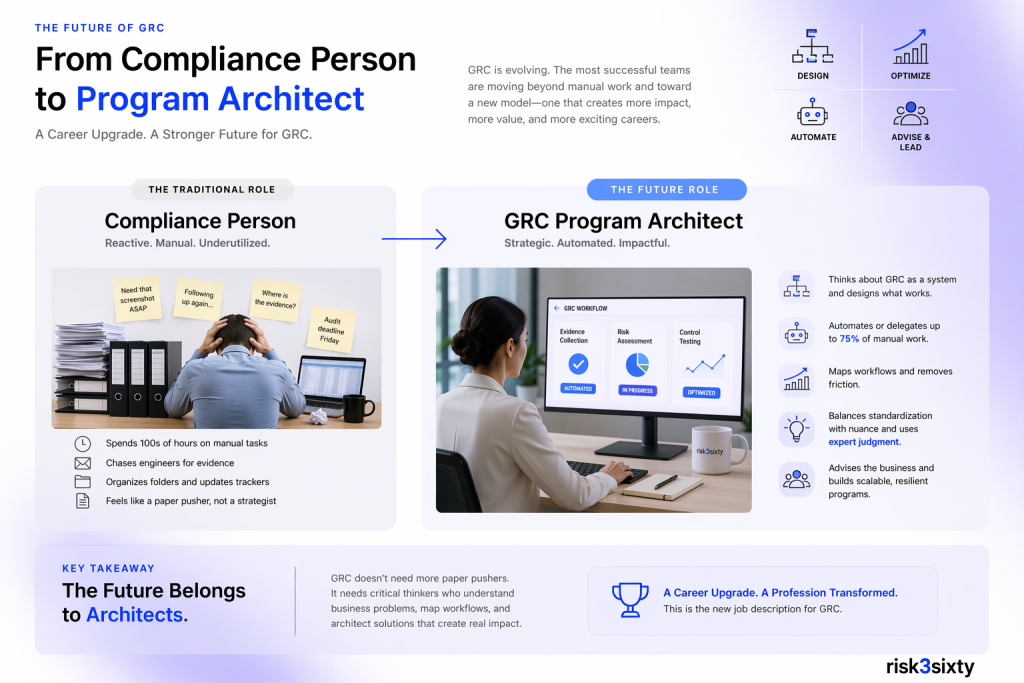
The Traditional GRC Role Is Being Redefined
Historically, many GRC teams have been built around the mechanics of audits and assessments. The work often revolved around evidence collection, policy management, spreadsheet tracking, and constant coordination across internal teams.
Some of that work is necessary. Much of it has been inefficient.
The issue is not that compliance work lacks value. The issue is that too much of the role has been shaped by tasks that do not require expert judgment. When highly capable GRC professionals spend hundreds of hours coordinating documentation and managing repetitive requests, the organization is underutilizing them and the profession itself starts to lose its identity.
GRC professionals develop a reputation as administratively necessary, but not strategic.
That is why so many people in GRC have felt disconnected from the strategic value of their own work. They entered the field to help organizations manage risk, improve resilience, and build trust. Instead, they got buried in workflows that made them feel more like document administrators than business advisors.
The good news is that this model is becoming harder to justify.
The Future of GRC Is Architecture, Not Administration
The best teams I work with are no longer thinking about GRC as a manual function. They are thinking about it as a system to design and optimize.
That change in mindset is everything.
When you view GRC as a system, the goal is no longer just to “get through the audit.” The goal is to design a repeatable, scalable, intelligent program that reduces friction, improves visibility, and lets experts focus on the decisions that actually matter.
That is where the program architect comes in.
A GRC program architect does not simply manage tasks. They assess how the compliance program operates across people, processes, and tools. They identify where work is slowing down, where handoffs are breaking, where evidence collection is too manual, and where automation can meaningfully reduce effort without sacrificing quality.
Most importantly, they make design choices.
They decide what should be standardized, what requires human review, where technology can help, and where nuance still matters.
That is a fundamentally more strategic job. And I wonder if most GRC professionals are ready for it?
Why Automation Is Elevating the GRC Profession
One of the biggest misconceptions about automation in compliance is that it makes GRC less important. In my view, the opposite is true.
Automation is not reducing the need for GRC expertise. It is challenging GRC professionals to reinvent themselves and level-up their skills to be more attached to the business's objectives.
When routine work is automated or handed off to intelligent systems GRC professionals can focus on higher-value responsibilities: interpreting control intent, improving workflows, aligning compliance requirements to business realities, advising stakeholders, and designing programs that scale.
In practical terms, that means a professional who used to spend hundreds of hours each year on manual tasks can now automate a significant percentage of that work. In many environments, 75% of the administrative burden can be reduced through better system design, better tooling, and the right use of automation.
That does not remove the need for GRC professions; however, it does change the skills GRC professionals need to be competitive in the job market in the coming years.
The future of compliance is a world with a new breed for expert.
The Rise of the GRC Program Architect
This is the role I believe more organizations will need over the next several years.
The GRC program architect sits at the intersection of compliance, operations, and systems design. They understand the regulatory and audit landscape, but they also understand workflow design, stakeholder friction, and how technology can be used to build a stronger operating model.
That requires a very different skill set than traditional compliance administration.
The best GRC program architects are able to:
- Understand business problems before proposing solutions
- Map workflows across teams and identify bottlenecks
- Balance standardization with organizational nuance
- Evaluate whether to build, buy, or adapt tooling
- Design audit and compliance processes that are scalable and sustainable
- Apply expert judgment where automation alone falls short
That last point is critical. Every company has nuances in how it operates. Every risk environment is different. Every control framework has interpretation challenges. The strongest GRC leaders will not be the ones who rely on generic templates or mass-market automation alone. They will be the ones who understand the business deeply enough to architect programs that actually fit.
And expert judgement is doggedly earned.
Why Expert Judgment Still Matters More Than Ever
The more technology enters GRC, the more valuable expert judgment becomes.
That may sound counterintuitive, but it is true.
Technology can speed up evidence collection. It can organize workflows. It can trigger tasks, centralize documentation, and reduce repetitive coordination. But it cannot fully replace the contextual thinking required to determine whether a control is designed effectively, whether a process is sustainable, or whether a compliance program aligns with how a business truly operates, or predict what a CISO needs to present to a board.
That is why I do not see the future of GRC belonging to paper pushers or check-the-box operators.
I see it belonging to critical thinkers.
Professionals who can interpret risk in context, map business operations into workable compliance systems,
and can use modern tools without becoming dependent on generic solutions.
In other words, professionals who can architect.
What This Means for GRC Careers
This shift creates a real opening for ambitious GRC professionals.
If your identity in the field has been shaped by manual tasks, there is now a chance to redefine it. The opportunity is to move from being the person who manages the process to being the person who designs the program.
That is a meaningful career upgrade and a new position of influence.
It means developing stronger systems thinking. It means learning how to evaluate tooling and automation. It means becoming more fluent in workflow design, process improvement, and business context and not just control language and evidence requests.
The professionals who make this transition will become significantly more valuable to their organizations because they will be helping shape how GRC operates, not just keeping it moving.
That is where the profession is headed.
How We Think About This at risk3sixty
This is exactly the kind of work our team is excited about at risk3sixty.
Our view is that effective GRC transformation starts by understanding a client’s actual workflows before building anything. That sounds obvious, but too many solutions in the market are designed for broad scalability first and operational fit second.
That approach misses the point.
Every program has nuance. The best GRC solutions are not the ones that force every organization into the same mold. They are the ones that balance consistency with real-world complexity. They reduce manual burden without oversimplifying the work that requires expertise.
I'm not talking about more tools, I'm talking about better architecture.
And designing better programs requires professionals who can think like architects.
The New Job Description in GRC
So what does the future job description actually look like?
It looks less like audit coordination and more like systems design.
It looks less like repetitive collection work and more like structured problem-solving.
It looks less like checking boxes and more like building scalable, resilient, intelligent compliance programs.
The future GRC professional will need to understand business problems, map workflows, identify friction, evaluate technology, and architect solutions that create leverage.
That is a more demanding role. But it is also a more meaningful one.
And for the right people, it is a far more exciting future.
Final Thought
There is a huge opportunity in GRC right now to upgrade the profession and your career along with it.
The organizations that move fastest will stop treating GRC as a documentation function and start treating it as a design challenge. And the professionals who thrive in that environment will be the ones who can combine judgment, business understanding, and technology to build programs that actually work.
That is the future I see for GRC.
 Christian Hyatt