











Secure Your Attack Surface
A security team that works like they're on your payroll
We deploy proactive security practitioners to find exposures, prove what's exploitable, and keep your attack surface covered—so your team can focus on higher-priority work.

TRUSTED BY
Exposure Management Done For You
Validate
Our team exploits the vulnerabilities in your environment to determine what's actionable.
Prioritize
Every finding is scored against CVSS and layered within the unique context of your business.
Act
Dedicated practitioners embedded in your program mobilize where it matters.
Running a software-only security program is leaving you exposed.
Your scanners surface thousands of findings every month. Few are exploitable.
Most security programs don't have the time or expertise to tell which is which.
ASM tooling generates alerts, but nobody validates whether they're exploitable
Scanners flag vulnerabilities in bulk. Your team spends weeks triaging false positives while genuinely exploitable exposures sit unaddressed.
Shadow IT and misconfigurations go undetected between tests
A marketing team spins up a microsite. A developer pushes an internal app to a public subdomain. Between annual assessments, these assets live in the wild with no detection.
Your team has the skills but not the bandwidth for continuous offensive operations
Vulnerability management backlogs, compliance obligations, C-suite initiatives. Your best people can't dedicate focused time to exposure management when they're spread across everything else.
You walk into security reviews knowing there are gaps you can't speak to
Without validated threat intelligence, security leaders leave things off the deck because they haven't had time to investigate. That uncertainty compounds.
Introducing
The only exposure management service where senior practitioners run continuous threat intelligence, manually exploit what's actually dangerous, and stay on every finding until it's closed. For good.
OSINT, breach data, dark web monitoring
Continuous surveillance of the channels threat actors are already using to map your environment, your people, and your credentials.
Manual exploitation by senior practitioners
Findings don't stop at a CVSS score. We exploit them in your environment, document the method, and show you the business impact.
Real exposures don't sit open
Every exploitable finding has a senior practitioner on it until it's closed. The control gap that let it through gets documented and fed back into your compliance program, so the same class of exposure can never reopen.

When we say “done-for-you,” we mean it
Embedded
A team that stays with your program
Dedicated practitioners who learn your environment over time, instead of rotating through junior analysts.
Reachable
A shared Slack or Teams channel
Real-time communication with the practitioners running your engagement, instead of tickets and support queues.
Included
Incident response, in scope
Ad-hoc investigations and same-day mobilization come with the contract, instead of a change order.
Live
Monthly strategy with the team
Working sessions with the practitioners running your program, instead of a report drop.
From kickoff to continuous coverage. In weeks.
Our structured, ongoing process surfaces exposure early, validates what's exploitable, and gives your team intelligence they can act on immediately.
Threat intelligence baseline
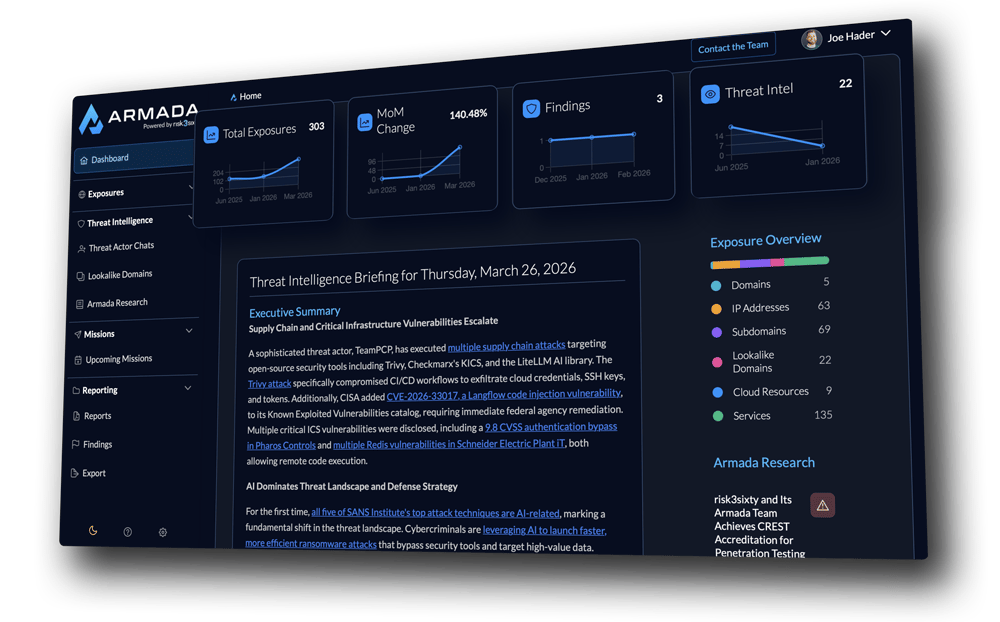
We map your environment the way a threat actor would: domains, credential exposures, breach data, dark web sources, lookalike domains. You get a consolidated briefing in month one.

Continuous discovery and monitoring
Armada scans your external attack surface continuously, flagging new assets, configuration changes, and emerging vulnerabilities. Critical findings trigger same-day alerts.

Contextual prioritization
We score findings against CVSS and layer on business context, so a server hosting financial systems gets prioritized differently than a staging environment.

Manual validation and exploitation
Our team exploits the vulnerability, documents the method, and shows the business impact. You see what's actually exploitable in your environment.
How we're different
The human layer that closes the gap.
ASM platforms only give you a list of findings. Armada gives you a team that proves what's exploitable and stays with your program.
| Typical ASM tooling | Armada Exposure Management |
|---|---|
|
Automated scanning with bulk alerts Hundreds of findings with severity scores. No validation of whether they're exploitable in your environment. |
Manual exploitation to prove impact We exploit the vulnerability, document the method, and show you the business impact. |
|
Static reports on a schedule |
Continuous scanning |
|
No business context in findings |
Prioritization by what the asset protects |
|
Support tickets for questions |
Direct access to your team |
Secure Your Attack Surface
Speed and depth at scale
You get 24/7 access to your asset inventory. When a new vulnerability is disclosed, log in, search for affected assets, export the list, and hand it to IT.

8 hrs
Average detection time for new exposure
500K+
Exposures under active monitoring
8 hrs
NPS across risk3sixty (industry avg: 57)
“Armada Exposure Management has 100%, hands down found things we didn't know existed, including look-alike domains and external exposures.”
Senior Security Program Manager, MapLarge
Real results from the field
Internal application exposed externally after misconfiguration
An internal app became publicly accessible after a misconfiguration. Armada detected it within eight hours. The client was unaware of the exposure. Shut down within hours of notification.
Third-party breach threatened client data
A partner company was breached. The client's second call was to Armada. The team mobilized within hours, assessed exposure through the partner, and began monitoring for data surfacing. No change order. No delay.
Enterprise client doubled their contract after evaluating pure-play ASM
A Fortune 500 organization with millions of assets evaluated a pure-play ASM tool and came back specifically for the manual validation and collaborative model.
27 data breaches surfaced in the first threat intelligence briefing
The first-month OSINT exercise identified 27 breach incidents, 64 compromised email accounts, and exposed passwords for specific employees. The client had never seen this consolidated in one place.
Frequently asked questions
Let's talk about your attack surface
ForTell us about your environment, and we'll walk you through how the engagement works and what the first month looks like.